
Gibraltar is a living lesson in geopolitics. On one side you have the European continent, while on the other side, there’s Africa.
It connects the Mediterranean Sea to the Atlantic Ocean; here, the world narrows to the width of a single strait.
The Mediterranean Sea separates Africa from Europe, and touches 21 countries. Yet many people may not realise that at their closest points, the two continents are only about 14km apart.
If you depart from the port of Tangier in northern Morocco and cross the Strait of Gibraltar, it takes less than 90 minutes by ferry to reach the Spanish port of Algeciras.
At least eight ferries run daily between the two shores, making the crossing feel almost like commuting between neighbouring cities.
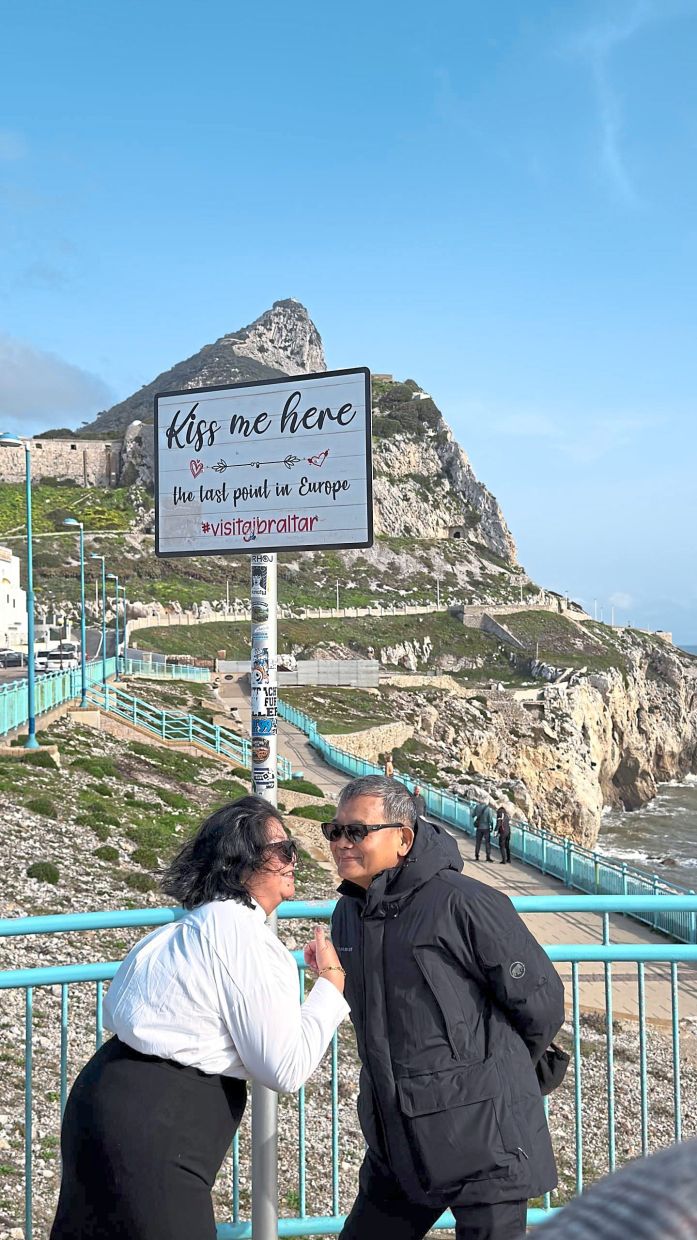
Two personalities, one strait
Standing on the deck of the ferry and watching the sea is a curious experience. As the ship heads north, the calm deep-blue Mediterranean lies on the right, while the broader Atlantic Ocean is on the left.
The two bodies of water meet on the Gibraltar Strait, yet they maintain their own colours and personalities. Measuring “short” stretch is not merely about geography – it is also a boundary between history and the present.
For thousands of years this strait has been a gateway for civilisations. Phoenicians, Romans, Arabs, Portuguese, Spaniards, and the British all sailed through these waters. Beneath the seemingly peaceful surface lie countless stories of imperial rise and decline.
After arriving at the ferry terminal in Algeciras and driving for about 30 minutes, you reach the border checkpoint of Gibraltar. Crossing that line, you suddenly realise you are stepping into somewhere rather unusual.
Gibraltar covers only 6.8sq km, yet it is densely packed with life. From afar, a massive limestone mountain rises abruptly from the ground like a stone aircraft carrier anchored beside the strait.
This is the famous Rock of Gibraltar.
I often tell my travel companions: If life brings you here, stay at least one night because Gibraltar is not just a sightseeing stop, it is a real-world classroom where history, geography, and politics intersect.
Only by spending some time here can one truly understand why this tiny place is so remarkably different from the rest.
Gibraltar sits at the southern tip of the Iberian Peninsula, bordering Spain. Looking south across the strait, you can see the mountains of Morocco.
Every day, oil tankers, cargo ships, naval vessels, and cruise liners pass through these waters. Nearly one-third of global maritime trade travels along this route, giving Gibraltar a long-standing strategic importance in shipping history.
What makes it even more intriguing is that this territory belongs to Britain, which is over 2,000km away.
The story dates back to the early 18th century. During the War of the Spanish Succession, European powers fought for control of the Spanish throne. In 1713, under the Treaty of Utrecht, Britain acquired Gibraltar from Spain and has held it ever since. More than three centuries later, the Union Jack still flies over the rock.
Spain, of course, has long hoped to reclaim sovereignty. Yet Gibraltar’s residents have repeatedly voted in referendums to remain under British rule. For locals, the issue involves not only historical sentiment but also economic interests and lifestyle.
The political map of the world is often full of such contradictions. For instance, the narrowest gap between Singapore and Malaysia is barely 500m, yet they are separate nations.
Geography alone does not determine political borders.
A financial pocket
Many people wonder: How does such a tiny place survive economically?
With nearly 40,000 residents, space is scarce in Gibraltar and property expensive. Yet a local tour guide said that many things in the country are actually cheaper than in Spain.
Spaniards often cross the border to buy fuel, cigarettes, or groceries. Some even commute daily to work in Gibraltar because salaries tend to be slightly higher.
The reason is simple: taxes.
Gibraltar has long maintained a low-tax policy and developed a mature offshore financial system. Financial services, insurance, online gaming, and maritime supply services form the backbone of the local economy. Cruise tourism and cross-border spending further strengthen its revenue.
So despite its small size, the quality of life here is high.
When Britain completed Brexit in 2020, Gibraltar once again became a political focal point in Europe. Questions about border arrangements with Spain and the movement of goods and people became negotiation topics.
In reality, daily life across the border is already deeply intertwined. Tens of thousands of Spanish workers enter Gibraltar every day and return home after work. The strait may be narrow, but lives here are closely connected.
Since the pandemic, cruise tourism has also rebounded. During peak season, as many as five large cruise ships may dock in the harbour on a single day, bringing thousands of visitors ashore.
The Rock is Gibraltar’s most famous landmark. Rising 426m above sea level, the limestone massif stands almost vertically beside the strait like a natural fortress wall. From the summit viewing platform, the panorama is breathtaking.
On clear days, the Moroccan coastline is visible across the water. In that moment, Africa feels almost within reach.
Inside the rock lies an enormous labyrinth of caves and tunnels. Natural caverns blend with man-made passages carved into the mountain.
The most famous is St Michael’s Cave. Under theatrical lighting, its stalactites resemble a natural concert hall. Today, concerts and performances are sometimes held there.
There is also the extensive tunnel network excavated during World War II. The British carved kilometres of passageways inside the rock, effectively transforming the entire mountain into a giant fortress against potential Nazi invasion.
Guarded by monkeys
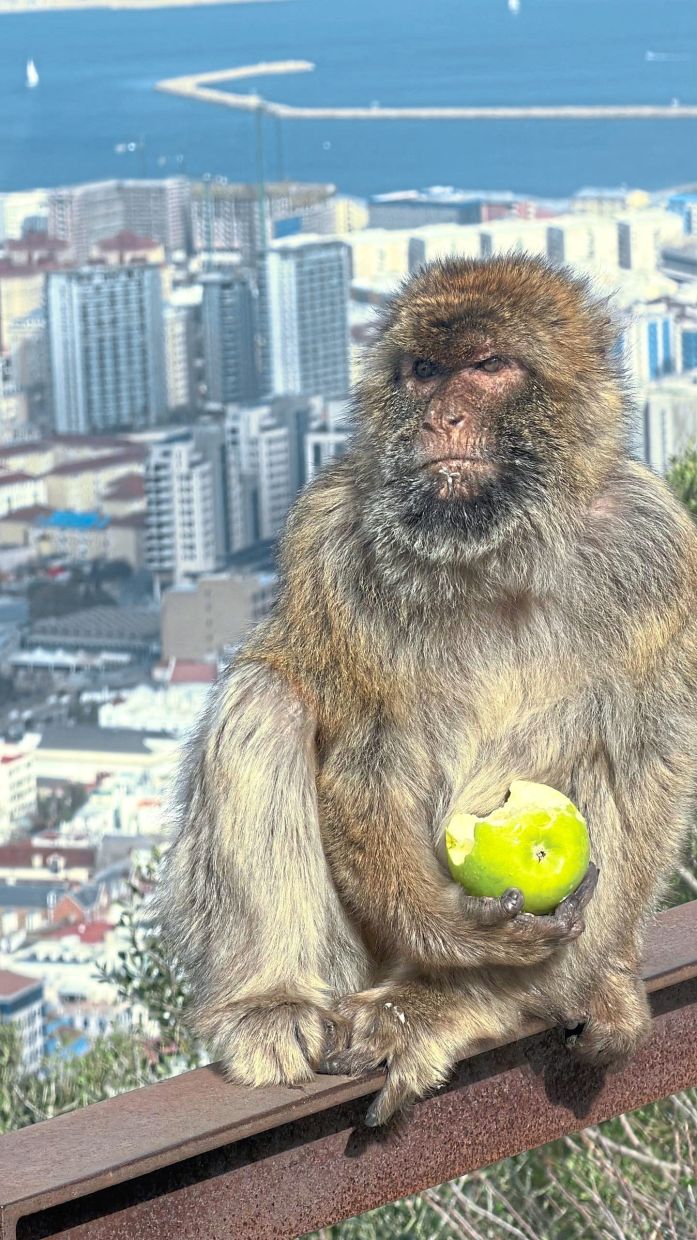
Beyond the rock itself, Gibraltar is famous for another unusual group of residents, the Barbary macaques.
These monkeys, originally native of the Atlas Mountains of North Africa, form the only wild monkey population in Europe.
No one knows exactly how they arrived in Gibraltar. Some believe the Moors brought them centuries ago, others say they crossed the strait naturally. Another theory claims they were introduced during World War II.
Former British prime minister Winston Churchill once joked that he personally allowed these monkeys to immigrate from North Africa.
During the war their numbers declined dramatically, but Churchill reportedly ordered additional monkeys to be brought from North Africa.
Today, the macaques have become Gibraltar’s most famous “residents”. Visitors who climb the rock will almost certainly encounter them.
Travel guides usually tell visitors to eat fish and chips while in Gibraltar. Perhaps that’s because tourists are plentiful and fish and chips are quick and easy to make and consume.
If you want something different, I recommend a Thai restaurant called Lek Bangkok, which has been operating for over 30 years. The owner is extremely chatty – sit down for a meal and you’ll hear plenty of local stories.
On my recent visit he said that many young people from Malaysia work in the office building across the street. I asked what they do. He shrugged: “Finance, maybe online gaming companies, I’m not entirely sure.”
That, in a way, captures Gibraltar’s charm. On the surface it feels like a quiet seaside town but behind the scenes, it functions as a small yet global financial hub.
This is certainly not the kind of place where you check in for an hour and leave. Walk slowly, watch the strait, look over the harbour, listen to local stories – you will realise that Gibraltar is like a condensed version of the world map.
Gibraltar has its own currency – the Gibraltar pound – which is pegged to the British pound. In daily transactions, however, both pound and euro are widely accepted.
The city features many English elements: red telephone boxes, British-style police uniforms, and the tradition of afternoon tea.
Yet because it borders Spain, traffic rules follow the European system.
The local English is unique as well. Mixed with Spanish and Mediterranean influences, it forms a distinct dialect known as Llanito.
If there is anywhere in the world where one can simultaneously feel the presence of Britain, Europe, and the Mediterranean spirit, Gibraltar would surely be one of those places.
Here, the world compresses into the width of a strait.
And history stands firmly upon that great rock.
The views expressed here are entirely the writer’s own.
Leesan, the globe-trotting traveller who has visited seven continents, including 164 countries and territories, enjoys sharing his travel stories and insights. He has also authored six books.